


Your shopping cart is empty!
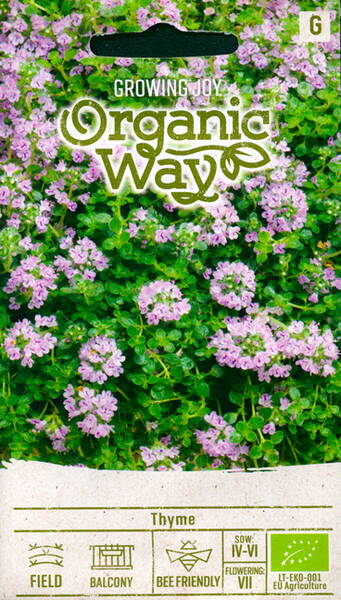
Garden thyme (25,0 g)
Prof Pack
New

Common Thyme - Thymus vulgaris L.
Common thyme is a small subshrub. The stem is highly branched, up to 40 cm high. The leaves are small (5-10 mm). The flowers are small, corollas are lilac-pink, sometimes white. Blooms in May - June.
* Common thyme is a fragrant, branched, erect subshrub of the Lamiaceae family, with ascending woody, tetrahedral, grayish-fluffy stems. Height is from 5 to 40 centimeters. The leaves are opposite, entire, small, oblong-lanceolate, with punctate glands and edges rolled downwards.
The flowers are small, pinkish-lilac, bilabiate, light lilac or pink in false whorls, collected in capitate or interrupted spike-like inflorescences. The calyx is campanulate, bilabiate, the corolla is bilabiate. There are four stamens, a long pistil with a bifurcated stigma. The fruit – a nutlet.
Grows in dry sandy places, steppe slopes, in shrubs, along river banks, roadsides, and along forest edges.
Collection time: June - July.
Common thyme is a small subshrub. The stem is highly branched, up to 40 cm high. The leaves are small (5-10 mm). The flowers are small, corollas are lilac-pink, sometimes white. Blooms in May - June.
* Common thyme is a fragrant, branched, erect subshrub of the Lamiaceae family, with ascending woody, tetrahedral, grayish-fluffy stems. Height is from 5 to 40 centimeters. The leaves are opposite, entire, small, oblong-lanceolate, with punctate glands and edges rolled downwards.
The flowers are small, pinkish-lilac, bilabiate, light lilac or pink in false whorls, collected in capitate or interrupted spike-like inflorescences. The calyx is campanulate, bilabiate, the corolla is bilabiate. There are four stamens, a long pistil with a bifurcated stigma. The fruit – a nutlet.
Grows in dry sandy places, steppe slopes, in shrubs, along river banks, roadsides, and along forest edges.
Collection time: June - July.
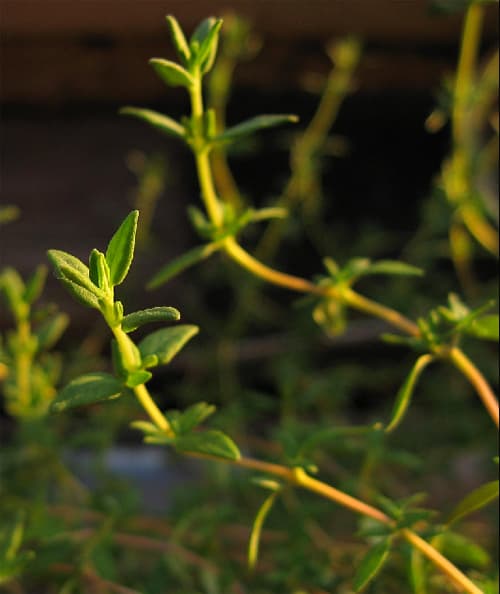
For medicinal purposes, harvest the aerial part of the plant. It is advisable to collect it in the phase of full flowering, cutting the aerial mass without the rough lignified lower parts of the stem with a knife or pruner. It must be dried in the shade in well-ventilated rooms. The shelf life of the raw material is 2 years.
Thyme herb contains: thymic acid, ursolic, oleanolic, caffeic, chlorogenic, quinic and other acids, thymus-saponin and flavonoids, essential oil, which includes thymol, carvacrol, cymene, pinene, borneol, caryophyllene, linalool and other substances.
Location: prefer sunny places. Plants can tolerate partial shade and even shade, but in such conditions they stretch out and bloom poorly.
Soil: areas with light, fertile, well-drained soil with an alkaline or neutral reaction.
Planting: can be done at any time - the plants are unpretentious and drought-resistant, but not in late autumn, as the plants must take root well before the frost.
Care: the plants do not need to be fertilized, at best you can add a little ripe compost or bone meal to the soil.
If thyme bushes are regularly trimmed, they will be dense and compact. This is done in early spring or after flowering. Shoots are shortened by about two-thirds (to the lignified part).
Watering is necessary only in a dry summer, when there is an active growth of young shoots and the plants are preparing to bloom.
There are no diseases and pests on thyme. Harm to plants is caused only by excessive moisture on heavy clay soils in prolonged, rainy weather, as well as winter damping-off (the best measure to combat this evil is good drainage and mulching the soil around the plants with fine gravel).
Reproduction: by seeds, cuttings and division of the bush.
The simplest is propagation by dividing the bush. For division, the bush is dug up, the roots are sorted out and the plant is carefully divided into parts. Twigs trailing along the ground are separated during the entire growing season and planted immediately in a permanent place or separately - for rearing.
1.0 g = 3400-4800 seeds.
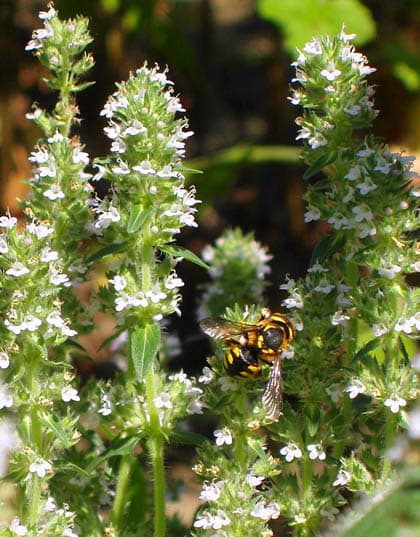
Garden thyme.